
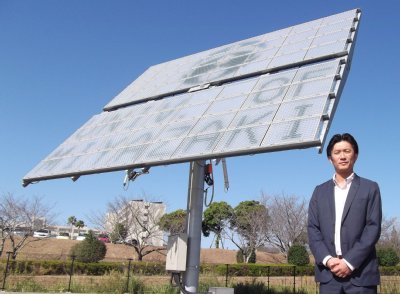
|
Affiliation |
Engineering educational research section Electrical and Electronic System Program |
|
Title |
Professor |
|
Homepage |
|
|
External Link |
|
|
Related SDGs |
|
NISHIOKA Kensuke
|
|
|




Degree 【 display / non-display 】
-
Doctor (Engineering) ( 2004.3 Nara Institute of Science and Technology )
Research Interests 【 display / non-display 】
-
Photovoltaic
-
Nano and material
Research Areas 【 display / non-display 】
-
Energy Engineering / Earth resource engineering, Energy sciences
-
Manufacturing Technology (Mechanical Engineering, Electrical and Electronic Engineering, Chemical Engineering) / Electric and electronic materials
Education 【 display / non-display 】
-
Nara Institute of Science and Technology Graduate School of Materials Science Materials Science
- 2004.3
Country:Japan
-
Osaka University Engineering Science Department of Chemical Science and Engineering
- 1998.3
Country:Japan
Campus Career 【 display / non-display 】
-
University of Miyazaki Engineering educational research section Electrical and Electronic System Program Professor
2025.04 - Now
-
University of Miyazaki Engineering educational research section Electrical and Electronic Engineering Program Professor
2024.04 - 2025.03
-
University of Miyazaki Engineering educational research section Research & Development Center for Sustanable Energy and Environmental Engineering Professor
2016.11 - 2024.03
-
University of Miyazaki Faculty of Engineering Department of Applied Physics Structural mathematical principle science course Associate Professor
2007.10 - 2016.10
External Career 【 display / non-display 】
-
Japan Advanced Institute of Science and Technology Assistant Professor
2004.4 - 2007.10
Professional Memberships 【 display / non-display 】
-
日本太陽光発電学会
2020.10
-
IEEE PVSC
2020.4
-
EU PVSEC
2020.4
-
フロンティア太陽電池セミナー
2018.4
-
宮崎県水素委員会
2017.4
Papers 【 display / non-display 】
-
Our recent approaches for Si tandem solar cell modules for solar-powered vehicles Reviewed
Yamaguchi M., Nakamura K., Ozaki R., Kojima N., Ohshita Y., Takamoto T., Juso H., Ota Y., Araki K., Nishioka K., Iwasaki S., Nakado T., Mabuchi T., Okumura K.
Solar Energy Materials and Solar Cells 297 2026.4
Language:English Publishing type:Research paper (scientific journal) Publisher:Solar Energy Materials and Solar Cells
Solar-powered electric vehicle (Solar-EV) applications are very attractive for CO<inf>2</inf> emission reduction and creation of new market. The Si tandem solar cells are very promising as VIPV (vehicle integrated photovoltaic) modules because of high-efficiency and low-cost potential. This paper presents our recent results for new world record efficiency (33.7 %) mechanically stacked 4-terminal InGaP/GaAs/Si 3-junction tandem solar cell module with an area of 775 cm<sup>2</sup>. This paper also presents loss analytical results for losses of various solar cell modules and estimation of solar-EV installed with various solar cell modules such as III-V/Si 3-junction, perovskite/Si 2-junction tandem cell modules, Si, GaAs, CdTe, and perovskite single-junction solar cell modules. Under average solar irradiation with 4 kWh/m<sup>2/</sup>day, solar-EV installed with our 3-junction Si tandem solar cell modules have longer driving range potential of about 28 km/day compared to 25.4 km/day, 21.6 km/day and 15.9 km/day for solar-EV installed with perovskite/Si 2-junction, Si and perovskite single-junction solar cell modules. Regarding perovskite and perovskite/Si tandem solar cell modules, development of high-efficiency, highly reliable and large-area modules is suggested to be essential for vehicle applications. In this paper, thermal degradation rates for perovskite and perovskite/Si tandem solar cell modules were compared with those of Si, III-V multi-junction and III-V/Si tandem solar cell modules.
-
Internal inspection of 3D-curved PV modules using non-destructive techniques Reviewed
Kaiki Matsubayashi, Daisuke Sato, Kenji Araki, Hiroyuki Satoh, Kensuke Nishioka
Solar Energy Materials and Solar Cells 301 114327 2026.3
Language:English Publishing type:Research paper (scientific journal) Publisher:Solar Energy Materials and Solar Cells
The rise of sustainable communication networks marks a transformative era in connecting our world, and non-terrestrial networks (NTN), especially high-altitude platform stations (HAPS), are at the forefront of this revolution. These innovative systems are not only vital for emergency communications and reaching remote areas, but they also embody our collective commitment to a sustainable and resilient future. Our groundbreaking study introduces an advanced energy simulation algorithm for HAPS, meticulously accounting for environmental factors that influence photovoltaic power generation. By modeling energy consumption across various flight phases, our findings reveal that solar energy production varies with time and location, with westward evening flights demonstrating peak efficiency. A comprehensive three-day simulation near Miyazaki Airport validates the extraordinary potential of HAPS, inspiring confidence in their practical application. Contrary to conventional beliefs that PV outputs remain stable at high altitudes due to minimal cloud cover, our measurements uncovered remarkable fluctuations shaped by curved-shaped behavior. We have successfully modeled this unusual phenomenon using sophisticated tensor-vector computation, paving the way for more reliable and efficient PV system designs.
-
Sin Pyae Pyae Shwe, Yadai Tomohiro, Yamamura Hiroshi, Suzuki Yoshihiro, Ota Yasuyuki, Nishioka Kensuke
Applied Sciences 16 ( 5 ) 2622 2026.3
Authorship:Corresponding author Language:English Publishing type:Research paper (scientific journal) Publisher:MDPI AG
Hydrogen production via water electrolysis using desalinated seawater offers a sustainable energy solution and has attracted considerable attention in recent years. However, its efficiency depends heavily on the quality of water. Many studies have not explored the relationship between treated water quality and hydrogen generation efficiency at each stage of the seawater desalination process. This study examines a three-step seawater desalination process comprising softening with ballasted flocculation (SBF) as a pretreatment, reverse osmosis (RO) as the main desalination step, and ion exchange as a polishing step to provide high-quality water for electrolysis. Water from each purification stage was supplied to the electrolyzer to compare the impact on water quality and hydrogen generation efficiency. The SBF process removed magnesium (Mg) and calcium (Ca) from seawater, as well as turbidity and bacteria, but hydrogen production via water electrolysis continued for no more than 10 h. However, when feeding RO water and RO water processed by ion exchange after the SBF process, hydrogen was generated stably and continuously for 70 h, achieving high efficiency comparable to that of commercial pure water. High production of green hydrogen by water electrolysis is possible through RO seawater desalination combined with SBF pretreatment.
-
Araki K., Komoto K., Tanaka M., Ota Y., Nishioka K.
Applied Sciences Switzerland 16 ( 5 ) 2026.3
Language:English Publishing type:Research paper (scientific journal) Publisher:Applied Sciences Switzerland
Featured Application: This technology is expected to be applied to vehicle-integrated photovoltaic systems and to policies for natural-disaster resilience. This study examines the potential contribution of Solar Electric Vehicles (SEVs) and Vehicle-Integrated Photovoltaics (VIPV) to disaster-related energy resilience through a probabilistic modeling framework. While previous research has highlighted the technical feasibility of EV-based support for microgrids and emergency facilities, it has paid limited attention to the behavioral uncertainty surrounding voluntary energy sharing by EV owners. To address this gap, we develop a Monte Carlo simulation model that integrates technical constraints, solar-generation variability, and heterogeneous participation probabilities to evaluate whether SEVs can sustain essential loads during prolonged outages. The analysis focuses on a worst-case scenario in which external lifelines are disrupted for seven days. Results indicate that approximately 450–1000 SEVs within a 5 km radius are required to maintain a continuous power supply, with BEVs requiring roughly twice as many units due to the absence of onboard PV generation. The findings highlight the sensitivity of resilience outcomes to user behavior and spatial vehicle distribution, underscoring the need for incentive mechanisms to encourage participation. Key limitations include simplified behavioral assumptions, region-specific irradiance conditions, and the exclusion of mobility constraints. Overall, the study provides a quantitative foundation for integrating SEVs into resilience planning while emphasizing the importance of social dynamics in determining real-world feasibility.
DOI: 10.3390/app16052566
-
Development of total energy simulator for high altitude platform station operation Reviewed
Mukai N., Araki K., Nishioka K., Okada K., Ota Y.
Solar Energy Materials and Solar Cells 296 2026.3
Language:English Publishing type:Research paper (scientific journal) Publisher:Solar Energy Materials and Solar Cells
The rise of sustainable communication networks marks a transformative era in connecting our world, and non-terrestrial networks (NTN), especially high-altitude platform stations (HAPS), are at the forefront of this revolution. These innovative systems are not only vital for emergency communications and reaching remote areas, but they also embody our collective commitment to a sustainable and resilient future. Our groundbreaking study introduces an advanced energy simulation algorithm for HAPS, meticulously accounting for environmental factors that influence photovoltaic power generation. By modeling energy consumption across various flight phases, our findings reveal that solar energy production varies with time and location, with westward evening flights demonstrating peak efficiency. A comprehensive three-day simulation near Miyazaki Airport validates the extraordinary potential of HAPS, inspiring confidence in their practical application. Contrary to conventional beliefs that PV outputs remain stable at high altitudes due to minimal cloud cover, our measurements uncovered remarkable fluctuations shaped by curved-shaped behavior. We have successfully modeled this unusual phenomenon using sophisticated tensor-vector computation, paving the way for more reliable and efficient PV system designs.
Books 【 display / non-display 】
-
水素の製造、輸送・貯蔵技術と材料開発 事例集
西岡賢祐( Role: Contributor)
㈱技術情報協会 2019.4
Language:Japanese Book type:Scholarly book
-
Concentrator Photovoltaic Systems: Introduction, Wiley Encyclopedia of Electrical and Electronics Engineering
Kensuke Nishioka, Yasuyuki Ota( Role: Joint author)
John Wiley & Sons, Inc. 2017.11
Total pages:12 Responsible for pages:12 Language:English Book type:Dictionary, encyclopedia
-
太陽熱発電の最新動向
西岡賢祐 (玉浦裕 監修)( Role: Joint author)
シーエムシー出版 2014.11
Language:Japanese Book type:Scholarly book
-
新太陽エネルギー利用ハンドブック 第Ⅴ編 太陽光発電技術
西岡賢祐( Role: Joint author)
一般社団法人日本太陽エネルギー学会 2013.12
Language:Japanese Book type:Scholarly book
-
高効率太陽電池
山口真史 監修( Role: Joint author)
NTS出版 2012.5
Language:Japanese Book type:Scholarly book
MISC 【 display / non-display 】
-
太陽光由来の貯蔵可能燃料 Invited
西岡賢祐
カーボン・エネルギーコントロール社会協議会 (CanApple): CanAppleニュース ( 230 ) 2022.4
Language:Japanese Publishing type:Article, review, commentary, editorial, etc. (trade magazine, newspaper, online media) Publisher:一般財団法人光産業技術振興協会
-
世界一の効率を達成した太陽光からの水素製造 Invited
西岡 賢祐
経済産業省 九州経済産業局 水素とともに描く地域・企業の未来 事例から紐解く!九州水素ガイドブック ( 49 ) 2022.4
Authorship:Lead author Language:Japanese Publishing type:Article, review, commentary, editorial, etc. (other)
-
MBD活用デジタル制御の太陽光発電・水素製造システム Invited
中島 善康、米澤 遊、太田 靖之、西岡 賢祐
エネルギー・資源 43 ( 251 ) 44 - 49 2022.1
Language:Japanese Publishing type:Article, review, commentary, editorial, etc. (trade magazine, newspaper, online media) Publisher:一般財団法人光産業技術振興協会
-
最新の太陽光発電応用技術 Invited Reviewed
西岡賢祐
オプトニューズ テクノロジートレンド 15 ( 3 ) 16 - 20 2020.9
Language:Japanese Publishing type:Article, review, commentary, editorial, etc. (trade magazine, newspaper, online media) Publisher:一般財団法人光産業技術振興協会
-
Multivariate Analysis Using R for Various Climatic Effects on the Output Performances of CIGS and Multi-Crystalline Si Photovoltaic Systems Installed in Miyazaki, Japan
Kyaw Myo WIN, Yasuyuki OTA, Kensuke NISHIOKA, Tatsuya SAKODA, Noriyuki HAYASHI
宮崎大学工学部紀要 49 119 - 127 2020.9
Language:Japanese Publishing type:Article, review, commentary, editorial, etc. (bulletin of university, research institution) Publisher:国立大学法人宮崎大学
Presentations 【 display / non-display 】
-
ZEB応用に向けた窓型太陽電池と熱電発電の複合利用
森 舞桜, 三浦 昌真, 太田 靖之, 西岡 賢祐, 池田 茂, 永岡 章
応用物理学会 2025年度 多元系化合物・太陽電池研究会年末講演会 (防衛大学校, 神奈川県) 応用物理学会 2025年度 多元系化合物・太陽電池研究会年末講演会
Event date: 2025.12.19 - 2025.12.20
Language:Japanese Presentation type:Poster presentation
Venue:防衛大学校, 神奈川県
-
高分子系分散剤を用いたPEM形水電解漕の回復手法
Pyae Pyae Shwe Sin, 宮原 正樹, 樋口 蓮, 後藤 大河, 西岡 賢祐
第45回水素エネルギー協会(HESS)大会 (東京大学 浅野キャンパス武田ホール, 東京都) 第45回水素エネルギー協会(HESS)大会
Event date: 2025.12.10 - 2025.12.11
Language:Japanese Presentation type:Oral presentation (general)
Venue:東京大学 浅野キャンパス武田ホール, 東京都
-
短時間酸処理による固体高分子形水電解の性能劣化回復効果
蜜石 祐也, 宮原 正樹, Pyae Pyae Shwe Sin, 樋口 蓮, 後藤 大河, 西岡 賢祐
第45回水素エネルギー協会(HESS)大会 (東京大学 浅野キャンパス武田ホール, 東京都) 第45回水素エネルギー協会(HESS)大会
Event date: 2025.12.10 - 2025.12.11
Language:Japanese Presentation type:Oral presentation (general)
Venue:東京大学 浅野キャンパス武田ホール, 東京都
-
固体高分子形水電解法における3価の弱酸を使用した性能回復方法
後藤 大河, 宮原 正樹, Pyae Pyae Shwe Sin, 樋口 蓮, 西岡 賢祐
第45回水素エネルギー協会(HESS)大会 (東京大学 浅野キャンパス武田ホール, 東京都) 第45回水素エネルギー協会(HESS)大会
Event date: 2025.12.10 - 2025.12.11
Language:Japanese Presentation type:Oral presentation (general)
Venue:東京大学 浅野キャンパス武田ホール, 東京都
-
金属イオン種による固体高分子形水電解セルへの影響評価
樋口 蓮, 宮原 正樹, Pyae Pyae Shwe Sin, 後藤 大河, 西岡 賢祐
第45回水素エネルギー協会(HESS)大会 (東京大学 浅野キャンパス武田ホール, 東京都) 第45回水素エネルギー協会(HESS)大会
Event date: 2025.12.10 - 2025.12.11
Language:Japanese Presentation type:Oral presentation (general)
Venue:東京大学 浅野キャンパス武田ホール, 東京都
Industrial property rights 【 display / non-display 】
-
洗浄方法
西岡賢祐, 樋口蓮, Pyae Pyae Shwe Sin, 後藤大河, 宮原正樹
Applicant:宮崎大学, 栗田工業株式会社
Application no:PCT/JP2025/039277 Date applied:2025.11.10
Announcement no:WO2026/110648 A1 Date announced:2026.5.28
Country of applicant:International (PCT) application
-
水の電解方法及び電解システム
西岡賢祐, 樋口蓮, Pyae Pyae Shwe Sin, 後藤大河, 鈴木祥広, 宮原正樹, 水野皓太
Applicant:宮崎大学, 栗田工業株式会社
Application no:PCT/JP2025/039276 Date applied:2025.11.10
Announcement no:WO 2026/110647 A1 Date announced:2026.5.28
Country of applicant:International (PCT) application
-
洗浄方法
西岡 賢祐、樋口 蓮、Pyae Pyae Shwe Sin、後藤 大河、宮原 正樹
Applicant:宮崎大学、栗田工業株式会社
Application no:2024-201887 Date applied:2024.11.19
Announcement no:2026-88952 Date announced:2026.5.29
Country of applicant:Domestic
-
水の電解方法及び電解システム
西岡 賢祐、樋口 蓮、Pyae Pyae Shwe Sin、後藤 大河、鈴木 祥広、宮原 正樹、水野 皓太
Applicant:宮崎大学、栗田工業株式会社
Application no:2024-201886 Date applied:2024.11.19
Announcement no:2026-088951 Date announced:2026.5.29
Patent/Registration no:7879561 Date registered:2026.6.16
Country of applicant:Domestic Country of acquisition:Domestic
-
熱電材料および熱電モジュール
吉野 賢二,永岡 章,西岡 賢祐,増田 泰造
Applicant:宮崎大学,トヨタ自動車株式会社
Application no:2020-199274 Date applied:2020.12.1
Announcement no:2022-087370 Date announced:2022.6.13
Patent/Registration no:7548796 Date registered:2024.9.2
Country of applicant:Domestic Country of acquisition:Domestic
Awards 【 display / non-display 】
-
Best Oral Presentation
2025.11 36th International Photovoltaic Science and Engineering Conference Can vibration resonance cause critical cracks or fatigue in c-Si modules? -- Non-contact measurement methods and findings
Kenji Araki, Ryota Tsuji, Yasuyuki Ota, Daisuke Sato, Tatsuya Takamoto, Kensuke Nishioka
Award type:Award from international society, conference, symposium, etc.
-
Best Poster Presentation
2025.11 36th International Photovoltaic Science and Engineering Conference A real-time simulation of power generation for automotive solar cells using digital twin technology
Nobuteru Takeshita, Naoki Mukai, Kenji Araki, Kensuke Nishioka, Shinya Iwasaki, Yohei Hosokawa, Satoru Kameyama, Yasuyuki Ota
Award type:Award from international society, conference, symposium, etc.
-
35th International Photovoltaic Science and Engineering Conference (PVSEC) Oral Presentation Award
2024.11 35th International Photovoltaic Science and Engineering Conference Organizing Committee PV for HAPS (High Altitude Platform): Tensor-Matrix-based modeling and measurement validation
Kenji Araki, Kohei Okada, Naoki Mukai, Shota Matsushita, Seiichi Kiyama, Yasuyuki Ota, Koji Nishiyama, Kensuke Nishioka
Award type:Award from international society, conference, symposium, etc.
-
35th International Photovoltaic Science and Engineering Conference (PVSEC) Poster Award
2024.11 35th International Photovoltaic Science and Engineering Conference Organizing Committee Rapid Generation of Solar Spectrum with Sensor Photodiode Arrays
Kaiki Matsubayashi, Kenji Araki, Yasuyuki Ota, Kensuke Nishioka
Award type:Award from international society, conference, symposium, etc.
-
学術研究者支援奨励賞
2024.8 株式会社九電工 地域のエネルギーと農資源を循環する地産地消システムの開発
西岡 賢祐
Award type:Award from publisher, newspaper, foundation, etc.
Grant-in-Aid for Scientific Research 【 display / non-display 】
-
固体高分子水電解における不純物起因劣化メカニズムの解明および特性回復手法の確立
Grant number:19K12401 2019 - 2022.03
科学研究費補助金 基盤研究(C)
Authorship:Principal investigator
-
高効率太陽電池材料の高倍率集光時におけるキャリアの動的ふるまいの解明
Grant number:25289360 2013.04 - 2018.03
科学研究費補助金 基盤研究(B)
Authorship:Principal investigator
高効率太陽電池材料の高倍率集光時におけるキャリアの動的ふるまいの解明
-
直線偏光Nd:YAGレーザーによる微細金属ドットの2次元規則配列加工に関する研究
Grant number:18760545 2006.04 - 2008.03
科学研究費補助金 若手研究(B)
コヒーレントな直線偏光Nd:YAGパルスレーザーを試料に照射することにより溶融金属内に自発的に発生するレーザー誘導周期的エネルギー密度分布を利用し、位置と大きさを制御した規則性配列微細金属ドットの形成に取り組んだ。直線偏光Nd:YAGパルスレーザーをSi酸化膜上に堆積したニッケル薄膜に照射するだけで、位置と大きさを制御した規則性配列微細ニッケルドットを形成することに成功した。
Available Technology 【 display / non-display 】
-
太陽光発電由来水素およびメタンの生成

各種太陽光発電システムの高精度発電量予測
地域のエネルギーと農資源を循環する低コストシステムMessage:太陽光発電の新規応用について研究開発を行っています。
メガソーラーの最適設置方法の検討や発電量予測について実績があります。
Committee Memberships 【 display / non-display 】
-
都城市カーボンニュートラル推進計画実施協議会 会員
2026.2
Committee type:政府
-
EU PVSEC 42nd European Photovoltaic Solar Energy Conference and Exhibition, Scientific Committee
2025.9
Committee type:学協会
-
宮崎市環境審議会 学識委員
2025.6 - 2027.5
Committee type:自治体
-
宮崎市脱炭素先行地域コンソーシアム 学識委員
2025.4
Committee type:自治体
-
35th International Photovoltaic Science and Engineering Conference Technical program committee (area chair)
2024.11
Committee type:学協会
Social Activities 【 display / non-display 】
-
技術情報協会 水電解技術の開発動向とCO2フリー水素の製造技術, 集光型太陽電池を利用したPEM水電解と水素製造技術
Role(s): Lecturer
2022.3.31
Audience: College students, Graduate students, Researchesrs, General, Company
Type:Seminar, workshop
高効率太陽光発電を活用する再生可能エネルギー由来水素およびメタン生成
-
宮崎県教育委員会 宮崎県県立学校長協会理数部会 令和3年度 第8回 宮崎県高等学校課題研究発表大会 自然科学講演会, 宮崎から再生可能エネルギー100%を目指して
Role(s): Lecturer
2022.3.15
Audience: College students, Graduate students, Researchesrs, General, Company
Type:Lecture
高効率太陽光発電を活用する再生可能エネルギー由来水素およびメタン生成
-
宮崎大宮高等学校 グローバル協創I グローバルプロジェクトII, 宮崎大学カーボンニュートラル
Role(s): Lecturer
2021.12.24
Audience: College students, Graduate students, Researchesrs, General, Company
Type:Lecture
高効率太陽光発電を活用する再生可能エネルギー由来水素およびメタン生成
-
令和3年度宮崎市環境学習指導者養成講座, 再生可能エネルギー100%の未来へ
Role(s): Lecturer
2021.12.18
Audience: College students, Graduate students, Researchesrs, General, Company
Type:Lecture
高効率太陽光発電を活用する再生可能エネルギー由来水素およびメタン生成
-
日本太陽光発電学会 次世代太陽電池セル・モジュール分科会
Role(s): Lecturer
2021.6.8
Audience: College students, Graduate students, Researchesrs, General, Company
Type:Seminar, workshop
高効率太陽光発電を活用する再生可能エネルギー由来水素およびメタン生成
Academic Activities 【 display / non-display 】
-
水素等を活用したエネルギー地産地消推進に関する構想策定委員会
Type:Academic research
-
宮崎県太陽電池・半導体関連産業振興協議会
Type:Academic research